When the Grid Goes Down: How Blackout Comms Keeps Your Family and Friends Coordinated


When cell towers stop working and the internet goes dark, a group of family and friends needs a way to stay coordinated without relying on infrastructure that no longer exists. People may be at home, checking on relatives, moving between locations, or running supplies. Without private communication and a shared picture of where everyone is, that effort turns into guesswork.

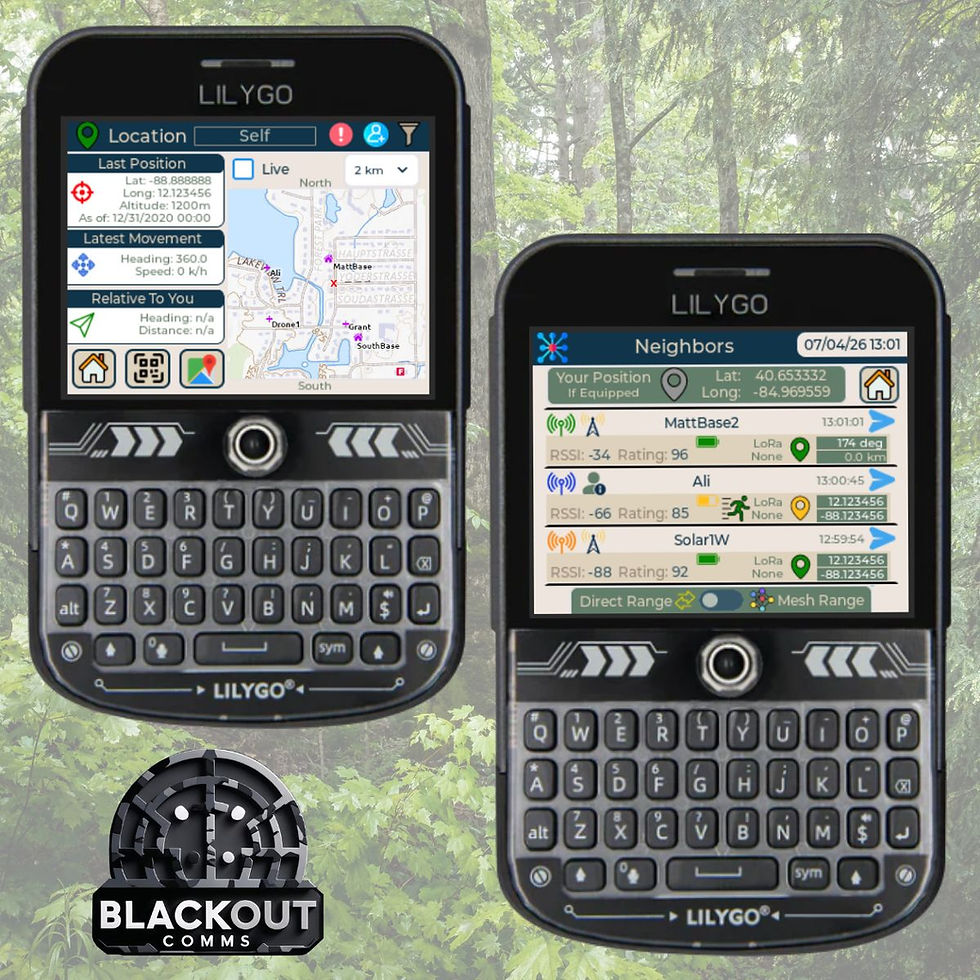
Blackout Comms is firmware that runs on inexpensive LoRa devices (such as the Lilygo T-Deck, T-Deck Plus, Lilygo Pager, Heltec V4, and others). It creates a private mesh cluster of trusted radios that can send encrypted text messages and share location information without cell service, internet, or central servers. The cluster itself holds the information, so individual devices do not have to stay powered on or in range for the group to retain useful awareness.
A Private Cluster Only Your Group Can Use
Devices are onboarded (one time) in person from a root device, forming a private mesh cluster. Radios that were never added are ignored. Direct messages use asymmetric encryption so only the intended sender and recipient can read them, even if other devices in the cluster help relay the packet. Broadcasts use the cluster’s shared keys so only members of your group can decrypt them. All traffic is digitally signed. The cluster also frequency-hops in an unpredictable pattern derived from its keys, which reduces the chance of casual monitoring or simple jamming. This means roadblock reports, resource updates, and movement information stay inside the group that set up the cluster.

Staying Found Even When Devices Go Quiet
Mesh Memory is the feature that keeps the operational picture intact. Every active device retains and propagates the last known state of every other device in the cluster: GPS position, heading, speed, and battery level. When a device powers off, drops out of range, or conserves battery, that information does not disappear. It remains available to the rest of the cluster and is shared with any device that later powers on or comes back into range.
On a map (on a licensed T-Deck or Pager screen, or the free Blackout Comms Live Android app connected over Bluetooth), you see active devices updating in real time and offline devices pinned at their last reported location. Direct messages can be held in the decentralized mesh cache for up to 24 hours and will still deliver when the recipient’s device comes back online. Broadcasts are retained for up to about 2 hours.

Privately Sharing Roadblock Locations and Resource Availability
This is where the system becomes practical for a family or friend group during a grid-down event.

Someone who encounters a roadblock can send a direct message to specific people or a broadcast to the whole cluster:
"road block at us27 and 218" - [time-stamped]
Because location sharing is continuous (unless you disable it) and encrypted within the cluster, recipients see both the message and the sender’s position (or last known position) on the map. There is no need to type out coordinates or rely on memory of landmarks. The same approach works for other movement updates: “Bridge at mile marker 14 still open,” or “Avoid the intersection near the school - debris in the road.”
Resource status is handled the same way. A person who reaches a gas station, store, water source, or pre-positioned cache can report what is available and under what conditions:
“Fuel at the station on Hwy 12. No lines as of 2 pm. 5 gal limit. Cash only.”
“Spring behind the old barn still flowing clear.”
“Cache at the north field edge is intact. Food and water still there.”
Updates can be sent as conditions change. Because the messages are encrypted and the cluster is private, outsiders do not see or hear the locations or the status reports. If the reporting device later powers off or moves out of range, Mesh Memory keeps its last position available so others still know where that report came from. A device left with a cache can be located by the rest of the group - permanently.
Direct messages are useful when the information should go only to one or two people. Broadcasts are useful for group-wide alerts that everyone should see, while still remaining private to the cluster. Both types are digitally signed, so the group can verify who sent the update.
How This Changes Coordination
A small group can keep a shared picture without constant radio chatter or reliance on phones that no longer work. Someone on a supply run can report progress and conditions while the rest of the group sees their last known position if they go quiet to conserve battery or reduce their RF footprint. People checking on relatives can confirm arrival or note obstacles. When the group needs to regroup or redirect, they can share current road conditions and resource points without broadcasting the information outside their trusted cluster.
The free Blackout Comms Live companion app for Android (or Overlook desktop companion) gives a larger map view of the entire cluster from any single connected device, including offline nodes and mesh links.
On-device maps on a T-Deck or Pager work without a phone after tiles are downloaded. Map tile use requires a Cluster License ($25 one-time, applied to the root, covers the whole cluster up to 90 devices). A free Community License covers up to three devices for basic messaging and location sharing without map tiles.
Get Started with Blackout Comms

If you already have compatible devices, setup is straightforward: flash the firmware, name the devices, create the cluster from the root, and onboard the others in person. Many users complete a small cluster in about 15 minutes. Devices can run for many hours on battery; solar or vehicle power extends that further. Range depends on terrain, antennas, and placement, but the mesh lets intermediate devices extend reach, and Mesh Memory keeps information available even when paths are intermittent.
Let Me Handle all the Setup

Don't have the time, patience, or expertise to order devices, flash firmware, and do the setup? As the Blackout Comms dev, I do this for people all the time. You may choose to:
Purchase a pre-configured device set
of any size (email me if you want something not listed).
Let me personally assemble, configure, and test your devices (all included in the prices you see)
Your devices arrive ready to power on and use with no additional setup required by you.
Final Notes
Blackout Comms does not replace voice radio, physical preparation, or common sense. It does give a family or friend group a private, encrypted way to share positions, roadblock locations, and resource status when the grid is down and ordinary communication is gone. The information stays inside the cluster you control, and it persists even when individual devices power off.