


Why Blackout Comms Uses LoRa
LoRa Technology for Off-Grid Communication
You’re on a scenic hike, miles from the nearest town. You pull out your phone to send a quick text, but you see the two words you dreaded: No Service. It’s a frustratingly common problem for anyone who ventures off the beaten path. What if you could create your own private messaging network, right there in your backpack, that works where your phone doesn't? A new kind of technology called LoRa makes this possible.

Think of LoRa as a special kind of long range radio for hiking and other remote activities. It allows small devices to “whisper” short messages to each other over miles, completely bypassing the need for cell towers or Wi-Fi.
Because it uses so little power, these devices can last for days or even weeks on a single charge. After you have the hardware, the off-grid communication is completely free—no subscriptions or monthly bills.While the idea of a personal radio network might sound complex, getting started is simpler than you think.
Thousands of outdoor enthusiasts and tech-savvy preppers are already using affordable LoRa devices to stay connected when there is no signal. This technology provides a reliable lifeline for your adventures, and you don’t need to be an expert to use it.
What is LoRa? The "Long-Range Text Message" That Works for Miles
The name stands for "Long Range," and the easiest way to think of it is as a radio signal designed for sending tiny bits of information. Imagine a text message or your GPS location—that’s the perfect size for a LoRa message. It’s built for sending a quick "I'm okay" or an alert from a remote sensor, but it's not for sending photos or browsing the web. LoRa is a specialist, not an internet replacement.

Unlike your phone, which needs a connection to a distant cell tower, LoRa devices can talk directly to each other. Think of them like a pair of super-powered walkie-talkies, but for text messages instead of voice. This creates your own private communication channel that works anywhere, completely independent of Wi-Fi or cellular service, making it a powerful tool for off-grid communication.This focus on small, simple messages is LoRa's secret weapon.
Watch some testing I recently performed to measure how far a Lilygo T-Beam 1W can send / receive.
By giving up the ability to handle large files, the technology gains two incredible superpowers that are impossible for Wi-Fi or cellular signals to match: unbelievable range and phenomenal battery life. But how does it manage to "whisper" a message for miles while barely using any power?
The "Whisper vs. Shout" Secret: How LoRa Gets Incredible Range and Battery Life
To understand LoRa's magic, imagine you’re trying to talk to a friend across a noisy, crowded stadium. You could shout (like Wi-Fi or cellular), which uses a ton of energy and gets drowned out quickly. Or, you could use a very distinct, slow, and quiet whistle that only your friend knows how to listen for. This is how LoRa works. It "whispers" data using a unique signal that other radio noise can't easily interfere with. Because the signal is so special, receivers can pick it up from miles away, even when it’s incredibly faint.
This "whispering" approach has a fantastic side effect: it barely uses any power. While your smartphone is constantly "shouting" for a cell signal, an encrypted P2P radio communicator using LoRa remains entirely silent unless sending a message. This makes it part of a new class of technology sometimes called a low power wide area network—designed specifically for efficiency over vast distances.
So, how far can this whisper travel? The maximum range of a LoRa signal depends entirely on your surroundings. In a dense city with lots of buildings, you might get less than a mile. But in open country with a clear line of sight, like from one hilltop to another, users have sent messages over 10 miles. Obstacles like mountains and heavy forests will reduce this range, but the results are still far more impressive than any technology you carry in your pocket today.

LoRa Messengers vs. Satellite Devices: A Cost and Use-Case Breakdown
When you venture off-grid, you might think of expensive satellite messengers as your only option. Devices from brands like Garmin or SPOT are incredible tools that can send an SOS from almost anywhere on Earth. However, they come with a hefty price tag for the device itself, plus a mandatory monthly subscription. LoRa technology offers a powerful and affordable alternative, designed for a totally different job. It’s less about calling for a global rescue and more about staying connected with your own group, for free.
The core difference between a LoRa vs satellite messenger boils down to purpose and price. Satellite devices are for broadcasting a signal to the outside world for help. LoRa devices are for talking amongst yourselves within a local area, making them fantastic emergency communication devices no subscription is needed for. Think of it as creating your own private chat group that works without cell towers.
Here’s a simple breakdown:

The right tool depends on your adventure. If you’re climbing a remote mountain solo, a satellite device is a non-negotiable piece of safety gear. But if you’re trying to keep track of friends at a festival, coordinating with family during a power outage, or looking for simple alternatives to ham radio for emergencies in your neighborhood, LoRa is the more practical and cost-effective choice.
Meet Blackout Comms: Your First Step into DIY Off-Grid Messaging
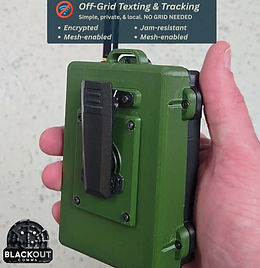
So, how do you actually turn one of these affordable LoRa boards into a user-friendly off-grid texting device? A popular option for this is Blackout Comms. Think of Blackout Comms as the software (firmware) layer that helps transform compatible LoRa hardware into a practical, secure messenger & tracker you can use in the field.
Device Types: Communicators and Mesh Links
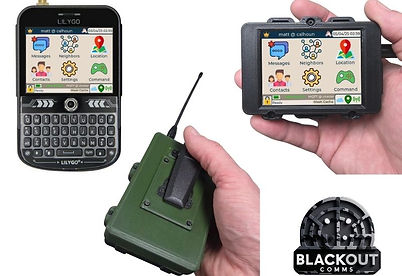
Blackout Comms has two different device types, Communicators and Mesh Links. Mesh Links are optional and really just extend the range of your private mesh cluster. Communicators are touchscreen devices you carry around, similar to how you would a phone. In fact, you use them in much the same way, like a texting / GPS app.
Check out our LoRa DIY plans and LoRa components for building your own devices.
Blackout Comms Devices
Blackout Comms works with both DIY and ready-to-use devices you can find on Amazon, Ali Express, the Blackout Comms online store, and other places.
.jpg)
Custom Private Mesh Kits from Blackout Comms
